
Player Case Study: Max's Journey to Elevating His Game

Updated: May 12

When Max joined the Matchfit Elite Football Athlete Programme, he was a talented 15-year-old footballer from Denmark competing at amateur level.
He primarily played as a winger and midfielder, positions that demand speed, stamina, agility, technical quality and the ability to perform consistently under pressure.
Max already had several natural strengths in his game. He described his biggest strengths as:
Technique
Dribbling ability
Passing quality
But despite those strengths, Max recognised something important. If he wanted to achieve his dream of becoming a professional footballer and eventually compete at the highest levels of the game, he needed to improve the physical side of his performance.
At the time he joined the programme, his goals were clear. He wanted to physically develop into a player capable of competing at professional level
The Starting Point
Before joining the programme, Max felt there were several areas holding him back from performing consistently at his best.
One of the biggest frustrations he experienced was inconsistency in matches. He explained that he often performed very well when training individually, but struggled to reproduce the same level consistently during team training sessions and competitive matches, especially under pressure.
Like many technically talented young footballers, the physical and mental demands of the match environment were affecting his ability to fully express his ability on the pitch.
Max had also experienced both heel and hip injuries, which had impacted his training consistency and overall development. Although he already had around two years of strength training experience, he felt he needed a more structured and football-specific approach to continue progressing. That was one of the key reasons he decided to join the Elite Football Athlete Programme.
The Fitness Assessment
Max completed a full football athleticism assessment to identify both his strengths and the areas that required the most attention. The assessment looked at key physical qualities needed for football performance, including:
Strength
Explosive power
Speed
Agility and change of direction
Core stability
Aerobic endurance
The results showed that Max already had a solid athletic foundation in some areas, but there was still significant room for improvement if he wanted to perform at a higher level.
Several areas stood out immediately. Upper body strength and core stability were identified as weaknesses relative to the level of athlete he wanted to become. His max press up and plank scores were both below the standard expected for a player with ambitions of reaching professional football.
The testing also highlighted room for improvement in his agility and sprint performance.
His 505 agility test times and 30 metre flying sprint times suggested he could become much quicker and more efficient when changing direction and accelerating at speed.
While Max already had a decent baseline of stamina, improving his conditioning levels would also be important to help him maintain performance levels throughout matches.
The Training Plan
Max's programme was designed around the specific areas identified during testing and focused on improving the physical qualities most important for his position and style of play. The training focused on developing:
Full body strength
Explosive power
Acceleration and sprint speed
Change of direction ability
Core strength and stability
Football-specific stamina and endurance
Alongside the physical training, Max also wanted to improve his nutrition to better support his recovery, performance and long-term development. But like with most players who make significant progress, the biggest factor behind Max’s results was consistency. Week after week, he continued following the programme, tracking his progress and building his athletic foundation.
Max’s Physical Development Results
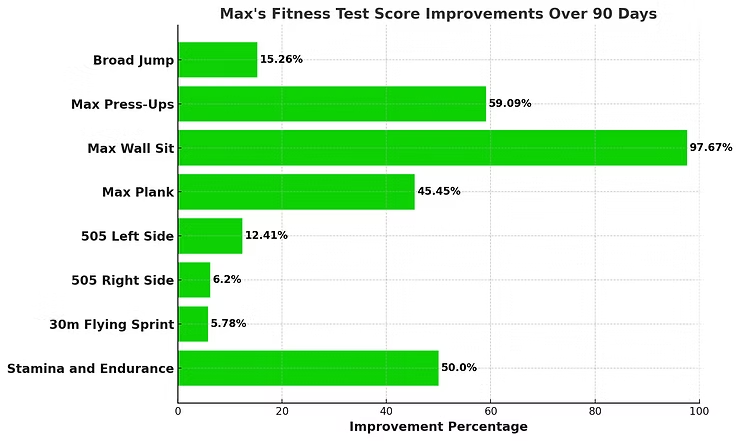
Over the first 90 days of the programme, Max achieved significant improvements across multiple areas of performance.
Here are some of the key changes measured through objective retesting.
🔥 Press Ups (Upper Body Strength) + 59.09% improvement
🔥 Wall Sit (Lower Body Strength & Endurance) + 97.67% improvement
🔥 Plank Hold (Core Stability) + 45.45% improvement
🔥 Broad Jump (Explosive Power) + 15.26% improvement
🔥 505 Change of Direction – Left + 12.41% improvement
🔥 505 Change of Direction – Right + 6.2% improvement
🔥 30m Flying Sprint (Top Speed) + 5.78% improvement
🔥 Stamina & Endurance + 50% improvement
Why Sprint Improvements Matter So Much
When looking at physical testing data, it’s important to understand that not all percentage improvements should be viewed the same way.
Strength and endurance tests can often improve rapidly once players begin following structured training consistently. Speed and agility tests are different. Because sprint tests are measured in very small time differences, even a slight improvement can create a huge impact on football performance.
Small gains in sprint speed and change of direction ability can influence:
Who reaches the ball first
Who wins 1v1 races
How much separation a player creates
How effective a player becomes in transition moments
So while sprint percentage changes may appear smaller on paper, they are often some of the most valuable improvements a footballer can make.
Performance Changes on the Pitch
The improvements Max made physically quickly began transferring into his performances during matches.
He noticed that he could maintain his energy and concentration levels for much longer during games. His increased strength and agility also made him more competitive in 1v1 situations, while his improved ability to change direction helped him become more effective both as a winger and midfielder.
Perhaps most importantly, he started feeling more capable of reproducing his ability consistently under match pressure.
Confidence and Mentality
One of the biggest changes for Max wasn’t just physical, it was psychological. Seeing clear improvements during retesting gave him a huge boost in confidence and motivation.
The measurable progress helped reinforce that his hard work was paying off, which made it easier for him to stay disciplined and consistent with his training.
As his physical ability improved, he also became more confident in his performances during matches. This connection between physical development and confidence is something we regularly see with young footballers.
When players feel stronger, fitter, quicker and harder to stop physically, they naturally begin to trust themselves more on the pitch.
The Bigger Picture
Without structured football-specific strength and conditioning training, Max likely would have continued struggling with consistency during matches while developing physically at a much slower rate.
Instead, within just the first 90 days of the programme, he made substantial improvements across strength, speed, agility, endurance and overall athleticism.
These improvements have already helped build a much stronger physical foundation to support his technical ability and long-term football ambitions.
And at just 15 years old, he is still only at the beginning of his development journey.
The Key Lesson
Max’s progress shows what can happen when a technically talented young footballer combines structured strength and conditioning training with consistency and long-term focus.
As he continues his training, the foundations he has built will support his continued development, bringing him closer to his ultimate goal of playing at the highest level in Denmark. The progress he has made so far is significant, and the potential for further growth over the coming months of the programme is promising.
Max is enrolled on our Elite Football Athlete programme, if you'd like more details for your son or daughter click the image below:


Comments