
The Biggest Mistake Late Developers Make in Youth Football

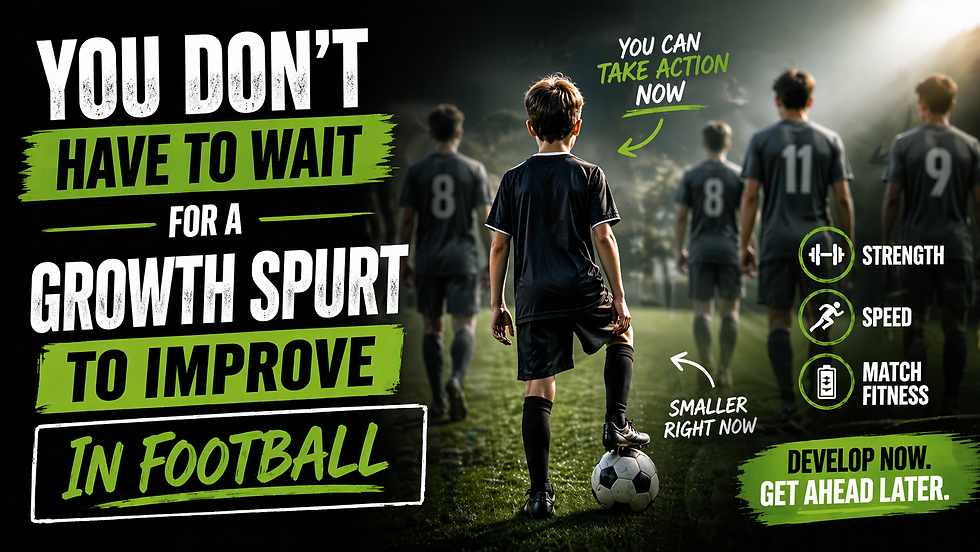
It’s not always obvious straight away when a player starts to get held back physically, because at younger ages technical ability can often carry them through both training and matches, allowing them to perform well enough that there aren’t any clear signs that something is missing.
Your child might be playing well right now, enjoying their football, and showing clear ability on the ball, which makes it easy to assume that everything is progressing as it should, especially if they’re coping well within their current environment.
However, as players begin to reach the ages where growth spurts start to occur, the game can change very quickly, and it’s often at this point that physical differences begin to have a much greater impact on performance.
Some players suddenly become taller, stronger, and more powerful within a relatively short space of time, while others develop later, and this is where many players start to feel like they’re falling behind, even though their actual ability hasn’t changed.
They might begin to struggle more in physical situations, arrive slightly later to key moments, and find it harder to maintain their level across a full match, which can be frustrating to watch because it often feels like they’re doing the right things, just without the same outcome.
The Belief That Holds So Many Players Back
At this stage, a lot of parents and players are told the same thing, which is that "they just need to wait for their growth spurt and everything will fall into place."
While there’s some truth in the fact that physical development changes over time, this way of thinking often leads to players doing very little to actually improve during one of the most important stages of their development.
Because while some players are waiting, others who have hit their growth spurt early are still actively working on their strength, speed, and conditioning through structured training, which means that even when natural growth eventually catches up, the gap is often still there.
Not because of size alone, but because of the physical training which some bigger players have continued to do.
What Growth Does and What It Doesn’t Do
One of the biggest misunderstandings at this stage is the assumption that growth alone will solve physical limitations, when in reality growth doesn’t automatically improve the qualities that actually matter in football.
Becoming taller doesn’t guarantee better balance or control under pressure.
Becoming heavier doesn’t automatically make a player stronger in physical situations.
And simply getting older doesn’t develop the speed, power, or ability to repeat high-intensity efforts that matches demand.
These are qualities that still need to be trained, and that’s why you’ll often see smaller players who are still able to compete physically, hold their own in duels, and maintain their intensity throughout matches, even when they’re up against bigger opponents.
They haven’t waited for change to happen, they’ve paid extra attention on developing the qualities that allow them to compete.
The Signs Start to Become More Consistent
As physical differences begin to show more clearly, the same patterns tend to appear more consistently in matches, even if they weren’t as noticeable before.
Your child might begin to get pushed off the ball more easily, even when they’re in good positions and making the right decisions, simply because they don’t yet have the strength to hold their ground under pressure.
They might find themselves arriving just slightly too late to key moments, not because they’re not reading the game well, but because they lack the speed and power to execute quickly enough when the intensity increases.
They may also start to fade as the game goes on, as the repeated high-intensity demands begin to take their toll, making it harder to maintain the same level of involvement and effectiveness.
These aren’t signs that they’re stuck or lacking potential, they’re simply signs that certain physical qualities need more attention.
Why This Stage Is Actually an Opportunity
What most people don’t realise is that this stage is one of the biggest opportunities a young player will have to gain an advantage, rather than something that should be seen as a setback.
Because if your child is currently one of the smaller players, they’re in a position where they can begin developing the physical qualities that many others neglect, particularly those who rely purely on natural growth to carry them forward.
They can build strength that allows them to stay more stable and controlled under pressure, develop speed and power that helps them compete more effectively in key moments, and improve their ability to maintain intensity throughout matches.
This means that instead of waiting to catch up, they’re actively putting themselves in a position to move ahead, and when growth does eventually happen, they’re not starting from scratch, they’re building on top of a strong physical foundation. That’s why some players suddenly surge ahead later on, not because they just grew, but because they can now combine increased strength, speed and power with their natural growth.
What To Do Next
If you’ve started to notice these changes in your child’s game, the key message isn’t that they need to wait, it’s that they can take action now in a way that directly improves their performance.
But that doesn’t come from doing more random training or just adding extra running sessions, it comes from following a structured approach that develops the specific physical qualities that actually transfer into matches.
That’s what the Elite Football Athlete Programme provides, a clear and progressive system that helps youth players build strength, speed, and match fitness in a way that directly impacts how they perform on the pitch.
The players who take action at this stage are the ones who will widen the gap in their favour when natural growth also catches up.


Comments